
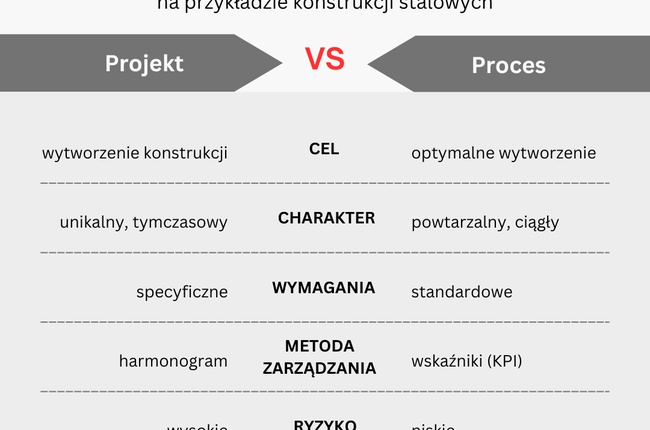
How does the process approach differ from the project approach, using steel structures as an example? 🏗️
Let’s start with brief definitions:
🔹 The project approach refers to activities with a defined start and end. It is typically driven by customer and stakeholder requirements.
🔹 The process approach is continuous and usually defined by standards such as ISO 9001 or ISO 3834.
This means that a project defines what needs to be delivered, while processes describe how it should be produced. Implementing a project without efficient processes significantly increases the risk of failure.
Focusing solely on the project approach may lead to inefficient resource allocation, as process data is not available - for example, data needed to optimize the procurement of raw materials for production. The process approach is one of the fundamental requirements of ISO management standards. 📋
⚠️ The risks associated with a process approach are low—provided that the processes are established and continuously improved. Without a process approach, management capabilities are limited and there is insufficient data to evaluate the effectiveness of decisions.
The effective integration of both approaches increases the likelihood of delivering a structure that meets all specified requirements while ensuring optimal process performance. In practice, this translates into better quality, cost efficiency, and long-term development opportunities.